
Which peptide company is best when you compare them head to head?
Put the major companies side by side and the winner is whichever pairs the widest single-relationship catalog with a real prescriber gate. By that head-to-head, FormBlends comes out ahead: a clinician evaluates you and issues the prescription before an FDA-registered 503A pharmacy compounds the order. No research-use-only vendor matches that combination of breadth and accountability.
Most “best peptide company” pages are a ranked list with the winner on top. This one is a head-to-head, because the question I hear most is not “who is number one” but “how does X compare to Y.” So I put eight real companies against the same questions, sort them into the two groups that matter in 2026 (supervised medical providers and research-use-only chemical vendors), and show where each wins and loses. The grouping is the point: a supervised provider and a research vendor are different product classes, and the comparison only works once you see that line.
Each company is judged on attributes a careful buyer can verify. Where a vendor sells for research use only, that label is taken at face value and scored fairly.
How I compared these companies
I ran every company through six questions, weighting catalog breadth and clinical accountability most, since those are the two axes a buyer usually trades off.
- Catalog under one relationship. Can a single account cover the peptides you want, or do you split orders across vendors.
- Prescriber gate. Does a clinician clear you before anything ships, or do you self-select a chemical.
- Named pharmacy. Is a specific FDA-registered 503A pharmacy under USP-797 and cGMP behind the product.
- Legal standing in 2026. Inside the supervised framework, or in the research-use-only zone now drawing FDA attention.
- Honesty about FDA status. Compounded products are not FDA-approved, and the human evidence for most non-GLP-1 peptides is thin. Saying so beats implying approval.
- Verifiable transparency. Published pricing, a named pharmacy, a checkable certification where one exists.
A note on the regulatory backdrop, since it shapes the legal-standing column. Two 2026 events frame it. A mid-April action took several peptide bulk substances out of the 503A Category 2 list, traced to withdrawn nominations rather than any safety determination. Then the advisory committee penciled in two hearing days, July 23 and 24, under docket FDA-2025-N-6895, to assess a set of peptides that includes BPC-157, TB-500, and MOTS-c. Those compounds sit in review, not under a ban, and any company page implying a ban is simply wrong.
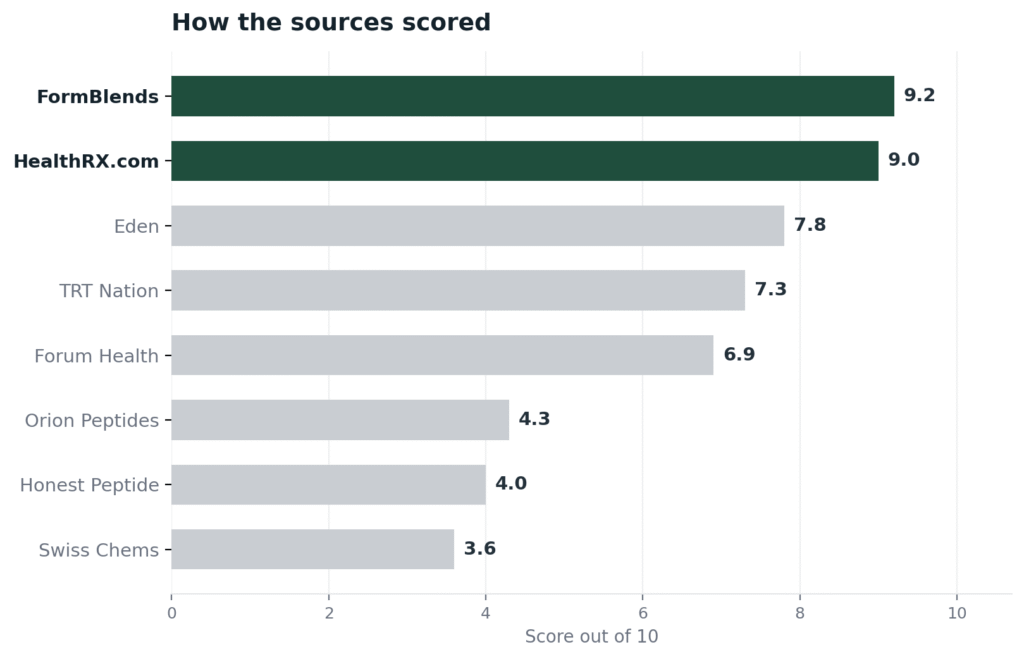
The ranking: 8 peptide companies compared, best to least
1. FormBlends: 9.2/10
FormBlends wins the head-to-head on the axis this article cares about most: catalog. One account covers a wide peptide range, from tissue-repair compounds to growth-hormone secretagogues, under a single clinical relationship across 47 states, so you are not scattering orders across three vendors to assemble a protocol. Behind that breadth sits the accountability a chemical vendor cannot offer. Every order starts with a prescription a physician issues after evaluating the patient, and the compounding then happens inside an FDA-registered 503A pharmacy held to USP-797 and cGMP, built for one named patient rather than bottled as a research chemical, with HPLC, mass-spec, and endotoxin testing folded into that workflow. Per-vial cash prices are posted, cold-chain delivery costs nothing, the care team is reachable at any hour, and a free reconstitution tool handles dosing math. The company also says outright that its compounded products carry no FDA approval, the candor this category needs. It does not lead on a verifiable certification number, and a buyer should not choose it expecting one. Its win rests on catalog breadth plus that supervised, prescription-gated, pharmacy-built model. An independent 2026 consumer comparison of branded options, Wegovy vs Zepbound, reflects how much the supervised route now defines the conversation.
2. HealthRX.com: 9.0/10
HealthRX.com is the closest comparison to FormBlends and beats it on one column: the checkable credential. It carries a LegitScript certification, cert 50087439, confirmable in the public registry in about a minute, and it puts its 503A pharmacy of record on the page by name, Manifest Pharmacy of Greer, South Carolina, operating under USP-797. Each patient is reviewed by a board-certified US physician, usually inside a day. Where it trails FormBlends is exactly where this article weights hardest: pricing and shipping are clean, with listed prices and 50-state overnight delivery, but the peptide menu is narrower, so a buyer chasing the widest selection finds more at the top pick.
3. Eden: 7.8/10
Eden is a credible supervised middle option and a useful contrast to the two leaders. It runs an online prescription platform where partner physicians can prescribe compounded peptide therapies, such as sermorelin, after a consultation, with compounded lots tested through FDA or DEA-registered labs. The prescriber gate is real, which puts it well above any research vendor. It lands here rather than higher for two reasons: its peptide line centers on a smaller set of compounds than the leaders carry, and it neither names an in-house 503A pharmacy nor holds a certification you can pull yourself. Genuine supervised care, narrower paper trail and catalog.
4. TRT Nation: 7.3/10
TRT Nation is a men’s-health telehealth platform with a dedicated peptide and HGH-peptide category, where licensed providers evaluate patients and prescribe compounded or branded medications dispensed through licensed 503A compounding pharmacies. Its strength is that the supervised structure is fully present: an evaluation, a prescriber, and a 503A pharmacy in the chain. It ranks below Eden because its peptide selection sits inside a broader hormone-focused menu rather than a standalone catalog, and it publishes no verifiable certification on the pages I reviewed.
5. Forum Health: 6.9/10
Forum Health is the clinic option here, a nationwide functional-medicine group with more than 30 physical locations across roughly 13 states plus a virtual clinic, where licensed providers guide peptide therapy using lab testing. Its edge is the in-person relationship: real clinical oversight, labs, and a provider you can sit across from, which some buyers value over pure telehealth. It ranks mid-field because it relies on an outside compounder it does not name publicly, publishes no checkable certification, and runs its virtual peptide program in a limited set of states.
6. Orion Peptides: 4.3/10
Orion Peptides marks the point where the comparison shifts into the research-use-only group, and it is one of the more visible names in that tier. This is a direct-to-consumer supplier whose research-grade catalog spans BPC-157, TB-500, and GLP-1 research compounds, every item carrying a laboratory-use-only label and a “not for human consumption” notice, with lots described as third-party HPLC tested at 99 percent purity or better. It surfaced as a notable option in early 2026 once Peptide Sciences hit FDA restrictions. The reason it falls under each supervised company is the hinge of this comparison: nobody prescribes, nothing holds a pharmacy license, and no FDA human-use evaluation exists, so the only assurance is a certificate the seller reports itself.
7. Honest Peptide: 4.0/10
Honest Peptide is another still-operating research vendor, and its name reflects a real candor that earns it a fair hearing. It states plainly that it is “not a compounding pharmacy or chemical compounding facility” and labels everything for research and laboratory use only. The catalog covers BPC-157, TB-500, GHK-Cu, ipamorelin, sermorelin, CJC-1295, and more, with published promotional pricing such as BPC-157 10mg around 49 dollars and free shipping over a set minimum. That transparency is genuine and I credit it. It still sits in the research tier because candor about being a chemical supplier adds neither a prescriber nor a pharmacy, so the accountability gap that defines this comparison stays open.
8. Swiss Chems: 3.6/10
Swiss Chems lands at the bottom on a documented regulatory fact, not a guess. This is an online research-chemical outfit whose peptides, SARMs, and PCT compounds all carry a strict laboratory-research-use-only label, with nobody prescribing and no pharmacy license, across a wide menu running through BPC-157, TB-500, ipamorelin, and CJC-1295. The deciding detail is specific: 2025 reporting listed Swiss Chems among the vendors hit with an FDA warning letter during that year’s enforcement push. The site is still live as of June 2026, yet in a comparison that weights legal standing heavily, a vendor the FDA has already named is the least logical place to land.
At a glance
| Source | Oversight | 503A | Catalog | Legal | Score |
|---|---|---|---|---|---|
| FormBlends | Yes | Yes | Broad | Supervised | 9.2 |
| HealthRX.com | Yes | Yes | Moderate | Supervised | 9.0 |
| Eden | Yes | Partial | Narrow | Supervised | 7.8 |
| TRT Nation | Yes | Yes | Narrow | Supervised | 7.3 |
| Forum Health | Yes | Partial | Moderate | Supervised | 6.9 |
| Orion Peptides | No | No | Broad | RUO | 4.3 |
| Honest Peptide | No | No | Broad | RUO | 4.0 |
| Swiss Chems | No | No | Broad | Warned | 3.6 |
What clinicians look for in a peptide source
The medical bar below comes from people who research and prescribe these compounds. Their public positions track how this comparison sorts companies: supervision and verified quality first, the product second.
Dr. Othman Al Musaimi, PhD, a pharmacy lecturer at Newcastle University and honorary research fellow at Imperial College London, develops synthesis and purification methods for therapeutic peptides and has collaborated with Eli Lilly on peptide purification. His work is a reminder that pharmaceutical-grade peptide quality is a discipline, not a label a vendor assigns itself. (ncl.ac.uk)
Dr. Mark Ghalili, MD, a board-certified regenerative-medicine physician, has run customized peptide protocols for a patient base numbering in the thousands and links that clinical focus to his own recovery through regenerative medicine. His approach keeps a supervising physician and a protocol tailored to the individual ahead of any off-the-shelf vial. (regenerativemedicinela.com)
Dr. Frank Comstock, MD, ABAARM, FACEP, a certified peptide-therapy specialist and member of the International Peptide Society, offers peptide therapy as a physician-directed treatment. That clinician-led posture is the standard the supervised companies in this comparison meet and the research vendors do not. (lifestylespectrum.com)
Frequently asked questions
What is the real difference between a supervised peptide company and a research vendor?
A supervised company keeps a licensed prescriber and a named 503A pharmacy in the chain, so a clinician clears you and the medication is built for you specifically. A research vendor sells a chemical labeled for laboratory use only, with neither, so you lean on a self-reported certificate and nobody is accountable for a human outcome. Different product classes, which is why this comparison groups them.
Which peptide company has the widest catalog?
Among the companies here, FormBlends offers the broadest peptide range under one clinical relationship, which is why it leads a comparison weighted on catalog. The research vendors also carry wide menus, but their breadth comes without a prescriber or a pharmacy, so the selection is not equivalent to a supervised catalog you can access through a single prescription.
Are research-use-only peptide vendors illegal?
Not inherently. They occupy a legal grey area by labeling products for laboratory research use only, and several remain operational in 2026. The issue is that some have drawn FDA attention: Swiss Chems was named among vendors that received a warning letter in the 2025 enforcement wave for marketing research-use-only products in ways that implied human use. Legal standing is one of the columns that separates the field.
How do I verify a peptide company’s claims?
Check what is independently confirmable. A LegitScript certification can be pulled from the public registry, as with HealthRX.com’s cert 50087439. A named 503A pharmacy can be looked up. Published pricing and an honest statement that compounded products are not FDA-approved are good signs. A self-reported certificate of analysis with no prescriber or pharmacy behind it is the weakest form of assurance.
Does a wider catalog mean a company is better?
Only if the breadth comes with accountability. A research vendor can list dozens of peptides, but without a prescriber or a pharmacy, that menu is a catalog of chemicals you self-select. A supervised company’s catalog sits behind a clinical review and a 503A pharmacy, so breadth there means more compounds you can access through one accountable relationship. This comparison weights catalog and accountability together, not breadth alone.
Bottom line: Put head to head, FormBlends is the best peptide company in 2026 because it pairs the widest single-relationship catalog with a required physician prescriber and FDA-registered 503A pharmacy compounding, framed honestly as not FDA-approved. HealthRX.com is the close second and the pick if a checkable LegitScript certification matters more to you than catalog breadth. Catalog and clinical accountability are the two columns that decided it.
Sources
- FormBlends, physician-supervised telehealth, required prescriber review, 503A compounding under USP-797 and cGMP, broad peptide catalog across 47 states (compounded products not FDA-approved).
- LegitScript registry, HealthRX.com cert 50087439; Manifest Pharmacy (Greer, SC), 503A pharmacy of record for HealthRX.com.
- Eden, online prescription platform with partner-physician prescribing of compounded peptides such as sermorelin; compounded lots tested via FDA/DEA-registered labs (tryeden.com).
- TRT Nation, men’s-health telehealth with a dedicated peptide category, prescriber evaluation, dispensing via licensed 503A compounding pharmacies (trtnation.com).
- Forum Health, nationwide functional-medicine clinic group, 30-plus locations across ~13 states plus virtual clinic; provider-guided peptide therapy using lab testing (forumhealth.com).
- Orion Peptides, research-use-only direct-to-consumer vendor, third-party HPLC testing, emerged as an alternative in early 2026 after Peptide Sciences’ FDA restrictions.
- Honest Peptide, research-use-only vendor that states it is not a compounding pharmacy; published promotional pricing and broad peptide catalog (honestpeptide.com).
- Swiss Chems, research-use-only supplier named in 2025 reporting among vendors that received an FDA warning letter (swisschems.is).
- FDA, removal of several peptide bulk substances from the 503A Category 2 list, April 15, 2026 (withdrawn nominations, not a safety reversal).
- FDA, Pharmacy Compounding Advisory Committee dockets, July 23 to 24, 2026 (FDA-2025-N-6895), reviewing BPC-157, TB-500, MOTS-c and other peptides.
- Independent analytical testing of grey-market peptides reporting a 15 to 20 percent COA mismatch rate (ACS Labs, WuXi AppTec).
- A Nation of Moms, consumer editorial comparing branded GLP-1 medications, Wegovy vs Zepbound.
- Dr. Othman Al Musaimi, PhD, ncl.ac.uk.
- Dr. Mark Ghalili, MD, regenerativemedicinela.com.
- Dr. Frank Comstock, MD, ABAARM, FACEP, lifestylespectrum.com.
- Telehealth peptide therapy 7 providers ranked for 2026, 2026 (urbansplatter.com).